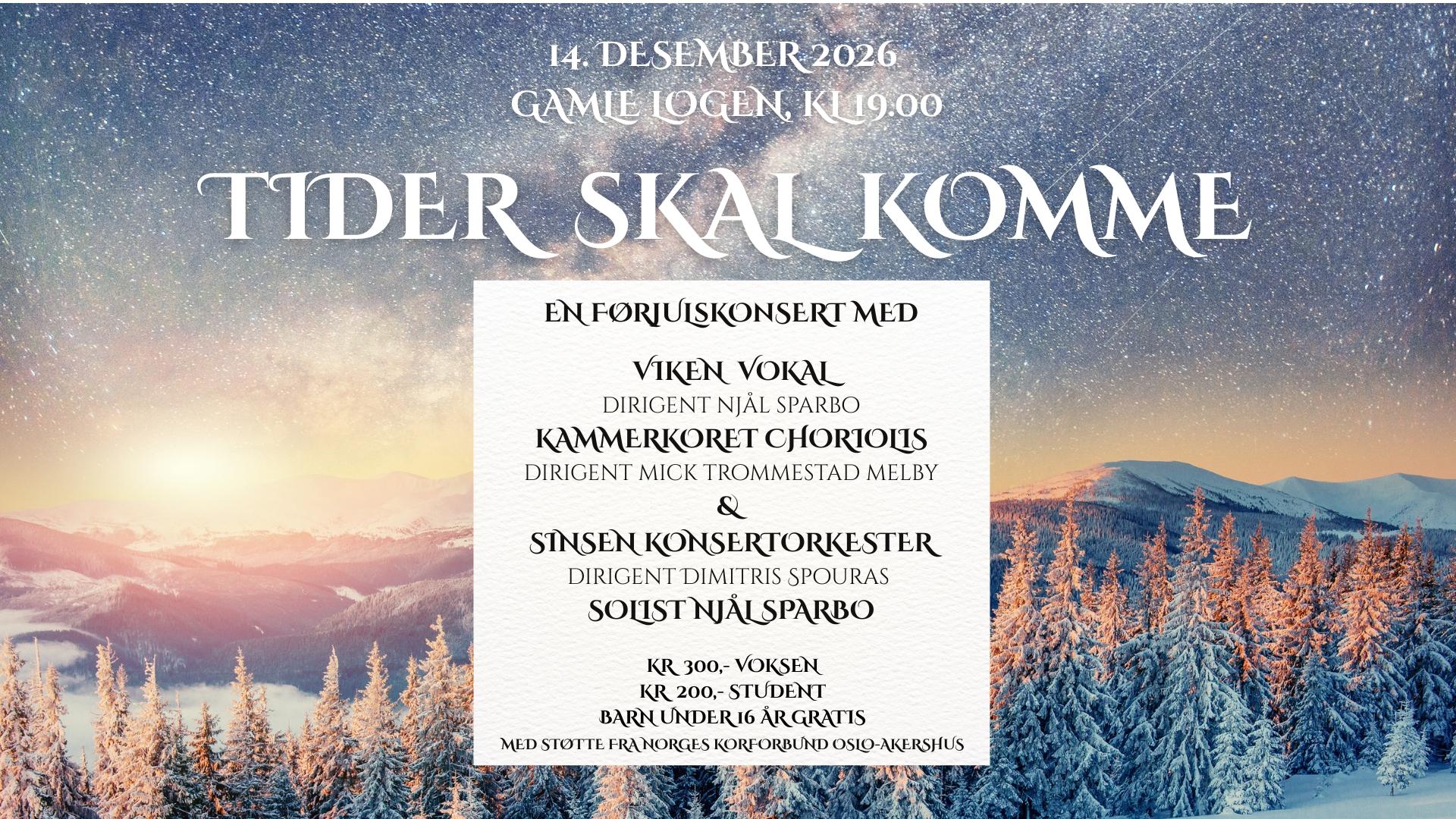
Times must come!
In a troubled world, it may seem paradoxical to celebrate. Yet throughout time, people have turned to music – to express what is difficult, to find hope, and to share joy in what still exists. This concert provides space for both seriousness and joy, reflection and community. Viken Vokal, the Chamber Choir Choriolis, and Sinsen Concert Orchestra come together for a concert that moves between the monumental and the intimate. The concert opens with Johann Sebastian Bach's Jauchzet, frohlocket! from The Christmas Oratorio – "rejoice, be glad!" The jubilation stands as one extreme in a program that also encompasses seriousness and contemplation. From Bach, the music transitions to Richard Strauss' solemn Feierlicher Einzug, before the orchestral sound gives way to the choirs alone. In Kling no klokka and När det lider mot jul, the Nordic Christmas tradition emerges. The first act concludes with the dancing elegance of Strauss' Schlagoberswalzer from the ballet Schlagobers. After the intermission, Strauss returns, now with bass-baritone Njål Sparbo as the soloist. In Die heiligen drei Könige aus Morgenland, the search of the three holy kings for the way to Bethlehem is depicted, with text by Heinrich Heine. From there, we are led into the existential center of the concert: Johannes Brahms' Schicksalslied – Song of Fate – based on Friedrich Hölderlin's poem from the novel Hyperion. In Hölderlin, the gods' bright and peaceful world stands in contrast to humanity's troubled existence, at the mercy of fate. Brahms allows this contradiction to unfold in music. But where Hölderlin's poem ends in darkness and uncertainty, Brahms chooses another path: After the choir has silenced, he lets the orchestra carry the music onwards to a wordless, reconciliatory conclusion. And perhaps this is precisely where the concert finds its way forward. For after the seriousness, the answer does not necessarily come – but the music continues. After Brahms, jubilation returns with Mendelssohn's Hark! The Herald Angels Sing and Handel's Hallelujah from Messiah. Finally, choir, orchestra, and audience gather in Deilig er jorden. The hymn can be difficult to sing when the world is marked by war and suffering. But precisely for that reason, the story behind it is worth knowing: The Danish poet Bernhard Severin Ingemann wrote the text in 1850, the same summer as the bloody battle of Isted took place during the Three Years' War. The hymn was published under the title Pilgrimssang, and the words about the earth's beauty and peace took on a particular resonance in a time marked by war. The hymn can be read as a protest against the idea that violence and destruction should have the final word. In the second verse, we also find the words that have given the concert its name: "Times shall come, times shall pass." It is a reminder that life and history continue, and that the hope for peace can be carried on from generation to generation. Participants Sinsen Concert Orchestra – conductor Dimitris Spouras Viken Vokal – conductor Njål Sparbo Chamber Choir Choriolis – conductor Mick Trommestad Melby Soloist: Njål Sparbo, bass-baritone Sinsen Concert Orchestra is a symphonic wind orchestra based in Sinsen, Oslo. The repertoire ranges from transcriptions of classical orchestral works to original compositions for wind instruments. The orchestra competes in Division 2 at the Norwegian Championships for wind orchestras and Division 1 in the regional championships of NMF East. Chamber Choir Choriolis is a mixed choir with around 30 singers. The choir's core area is classical music from various periods, but the repertoire also includes popular music, folk music, and jazz. Viken Vokal is a chamber choir with around 20 experienced singers. The choir explores various musical expressions with an emphasis on artistic and vocal technical development, both for the ensemble and the individual singer. Njål Sparbo, soloist, has an extensive career in opera, songs, and church music and has distinguished himself as a versatile performer, including 35 CD recordings. He ha